Every year millions of waste tires are generated worldwide from passenger vehicles, trucks, agricultural machinery, and industrial equipment. These discarded tires pose significant environmental challenges because rubber is extremely durable and difficult to decompose naturally.
Tire recycling has therefore become an important industrial solution for transforming waste tires into valuable raw materials. Instead of being burned or buried in landfills, used tires can be mechanically processed into rubber granules, rubber powder, steel wire, and textile fibers.
These recycled materials are widely used in industries such as road construction, sports surfaces, automotive products, and rubber manufacturing. Because of the growing demand for recycled rubber materials, tire recycling plants have become increasingly attractive investment projects in many countries.
Starting a tire recycling business requires proper planning, the right equipment configuration, and a clear understanding of the recycling process.
Modern tire recycling systems are capable of processing a wide range of tires from different industries. Typical recyclable tire types include passenger car tires, truck and bus tires, agricultural tractor tires, and industrial vehicle tires.
Most recycling plants are designed to process tires with diameters up to about 1200 millimeters. Larger mining or off-road tires can also be processed after pre-cutting or bead removal.
During recycling, the tire structure is separated into its main components. These include rubber materials, steel wire from the tire reinforcement, and textile fibers used in the tire structure. Each of these materials can be recovered and reused in different industries.
A typical tire recycling plant uses mechanical processing technology to gradually reduce the size of the tire while separating the different materials.
The recycling process usually consists of several stages including pretreatment, primary shredding, grinding, and material separation.
The recycling process normally begins with pretreatment equipment that prepares the tire for size reduction.
A tire debeader removes the steel bead wire from the tire sidewall. Removing the bead wire helps reduce wear on shredding blades and improves the efficiency of the entire recycling process.
Some recycling plants also use a tire cutter to divide whole tires into several pieces. Cutting the tire before shredding reduces the load on the shredder and improves feeding stability.
After pretreatment, the tires enter the primary shredding stage. A tire shredder machine is typically used in this process to reduce whole tires into manageable rubber blocks.
The shredder uses two counter-rotating shafts equipped with heavy-duty blades to tear the tire structure apart. The output material from this stage is usually rubber blocks approximately 50 millimeters in size.
Primary shredding significantly reduces the tire volume and prepares the material for further processing in downstream equipment.
Once the rubber blocks are produced, they are transferred to grinding equipment such as a crusher mill or granulator.
The crusher mill further reduces the rubber blocks into smaller rubber granules. In many tire recycling systems the output size at this stage is approximately 1 to 2 millimeters.
During the granulation process most of the embedded steel wire is released from the rubber structure.
After granulation, magnetic separation systems are used to remove steel wire from the rubber material.
Magnetic separators attract and remove steel particles, allowing the rubber granules to continue through the production line. In modern recycling plants the steel separation efficiency can reach more than 99 percent.
Recovered steel wire is often sold to metal recycling companies where it can be melted and reused for manufacturing new steel products.
The final stage of the recycling process involves removing textile fibers from the rubber granules.
Tires contain fiber materials such as nylon, polyester, rayon, and other synthetic fibers. A fiber separator uses airflow or mechanical separation to remove these lightweight materials from the rubber granules.
After this stage the final product becomes clean crumb rubber or rubber powder suitable for industrial applications.
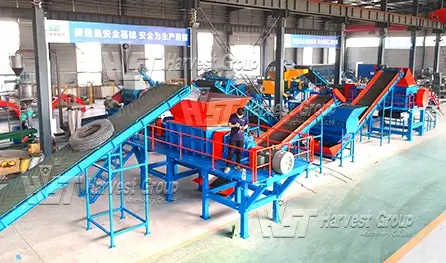
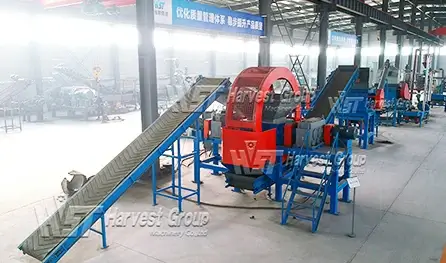
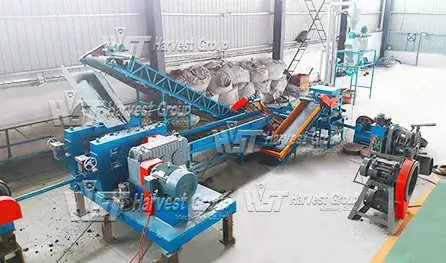
A tire recycling production line consists of several machines working together as a complete processing system. Many investors choose integrated tire recycling equipment to ensure stable operation and efficient material separation.
The tire debeader removes the steel bead wire from the inner ring of the tire. This machine is commonly used when processing truck tires or large radial tires.
Removing the bead wire before shredding helps protect shredding blades and reduces maintenance costs.
The tire cutter is used to divide whole tires into smaller sections. Cutting the tire into pieces improves feeding efficiency and reduces stress on the primary shredder.
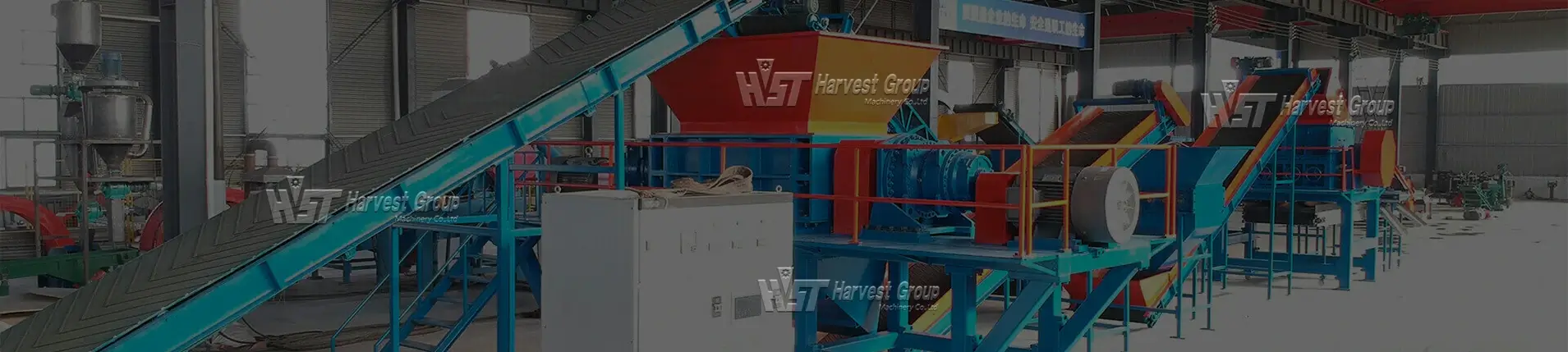
The double shaft shredder is the core machine in most tire recycling plants.
This machine processes whole tires or cut tires and reduces them into rubber blocks of approximately 50 millimeters. Typical shredders used in recycling plants can process around 1 to 3 tons of tires per hour depending on the model and motor power.
The crusher mill reduces rubber blocks into small rubber granules. In many recycling systems the output size ranges from 1 to 5 millimeters.
These granules can either be sold directly or further processed through a rubber powder production line to produce finer rubber powder.
The production capacity of a tire recycling plant depends on the equipment configuration and the desired final product size.
Small recycling plants often process around 800 kilograms to 1 ton of tires per hour. Medium-sized recycling facilities may process 2 to 5 tons per hour, while large industrial plants can handle more than 10 tons per hour.
A typical 1 ton per hour tire recycling plant usually requires approximately 200 square meters of factory space. Once the system is fully automated, the production line can often be operated by only two or three workers.
Recycled rubber materials have a wide range of applications across many industries.
Rubber granules and rubber powder are commonly used in sports surfaces such as playgrounds, running tracks, and artificial turf fields. They are also used in rubberized asphalt for road construction.
Other applications include automotive parts, rubber floor mats, sound insulation materials, and industrial shock-absorption products.
Because recycled rubber can replace part of the virgin rubber used in manufacturing, the demand for crumb rubber and rubber powder continues to grow worldwide.
A tire recycling plant is usually designed to allow materials to move through the processing stages in a continuous flow.
A well-designed plant layout is often part of complete tire recycling solutions that integrate shredding, separation, and granulation systems.
The tire feeding area is typically located near the raw tire storage zone so that loaders or conveyors can easily transport tires to the production line.
After the feeding section, the shredding area handles the largest and heaviest materials. Primary shredders reduce whole tires into smaller rubber blocks that can be processed further.
Downstream from the shredding stage, grinding and granulation equipment continue reducing the rubber size. Steel wire and textile fibers are gradually separated through magnetic separators and fiber separation systems.
The final section of the plant is usually dedicated to screening, storage, and packaging of finished rubber materials.
The investment required for a tire recycling project depends mainly on production capacity, automation level, and equipment configuration.
Small recycling plants processing around one ton of tires per hour usually require a relatively modest investment compared with large industrial recycling facilities.
The main cost components of a recycling plant include tire shredding equipment, granulation machines, magnetic separation systems, conveyors, dust collection equipment, and electrical control systems.
Additional costs may include factory construction, power supply installation, labor costs, and transportation equipment for handling waste tires and finished rubber materials.
Because recycled rubber materials have stable demand in many industries, properly designed recycling plants can achieve long-term operational profitability.
The demand for recycled rubber products has been growing steadily in many countries due to environmental regulations and the increasing cost of raw materials.
Crumb rubber and rubber powder are widely used in road construction, rubberized asphalt, playground surfaces, sports tracks, and industrial rubber products.
In some regions recycled rubber granules are also used in rubber flooring, shock-absorbing materials, and automotive components.
Because recycled rubber can partially replace virgin rubber in manufacturing processes, many industries are actively increasing their use of recycled materials.
Tire recycling can be profitable when the plant is properly designed and when there is stable demand for recycled rubber materials.
Revenue from a tire recycling facility usually comes from several sources including rubber granules, rubber powder, and steel wire recovered during the recycling process.
Profitability depends on factors such as local tire supply, market demand, energy costs, and equipment efficiency.
A tire recycling machine uses mechanical processing to reduce whole tires into smaller rubber materials through shredding, grinding, and separation stages.
A complete recycling system normally includes shredders, granulators, rasper machines, magnetic separators, fiber separators, conveyors, and dust collection equipment.
Small recycling plants processing about one ton of tires per hour can operate in relatively compact industrial spaces.
Waste tires can be converted into rubber chips, crumb rubber, rubber powder, steel wire, and textile fibers.
Yes. Tire recycling reduces landfill waste and converts used tires into valuable industrial materials.